
5 Scientifically Proven Mental Health Exercises That Help
Introduction:
We know we all have been there! We often go through days when the mind refuses to coordinate. We try our best sitting down in front of the desktop, trying to concentrate, but our thoughts keep dissipating. What’s worse is the sleep cycle breaks. We tell ourselves to push through. But nothing seems to work.
And there you are now, in complete distress, scrolling through the internet on how to escape from this complete mental spiral.
The question here is how often we have heard the undeniable benefits that one can derive through mental health workouts. It’s quite stupefying that physical movements are usually identified and limited to keeping our bodies in shape. But what about the mental stability and sanity? In reality, physical exercise carries a lot of potential for our cognitive wellness.
The World Health Organization (WHO) stated that roughly 1 out of 7 people around the world were suffering from mental disorders in the year 2021. And that speaks volumes!
However, the good news is that through simple daily activities, such as a 20-minute brisk walk, a mild stretch, or a few steady breathing movements, are all that you need. Because every small step, repeated daily, begins to transform the mental behavior positively.
And that’s where mental health exercise steals the spotlight. However, one shouldn’t consider it as a cure-all, but rather as a steady tool.
Why is Mental Health Exercise Crucial for a Fitter Mind?
The link between physical activity and mental health is a slow yet reliable process that can’t be ignored. It shows up in measurable shifts inside the body.
Consider the cues below once you start embracing physical activities in your day-to-day routine.
-
Heart rate becomes stable
-
Stress hormones fall
-
Blood flow to the brain increases
-
Sleep cycles begin to stabilize
These changes explain why fitness and mental health are closely tied. The body adjusts first, and the mind follows. So, keep reading to the end of the blog to find out what the best exercise for your mental health is.
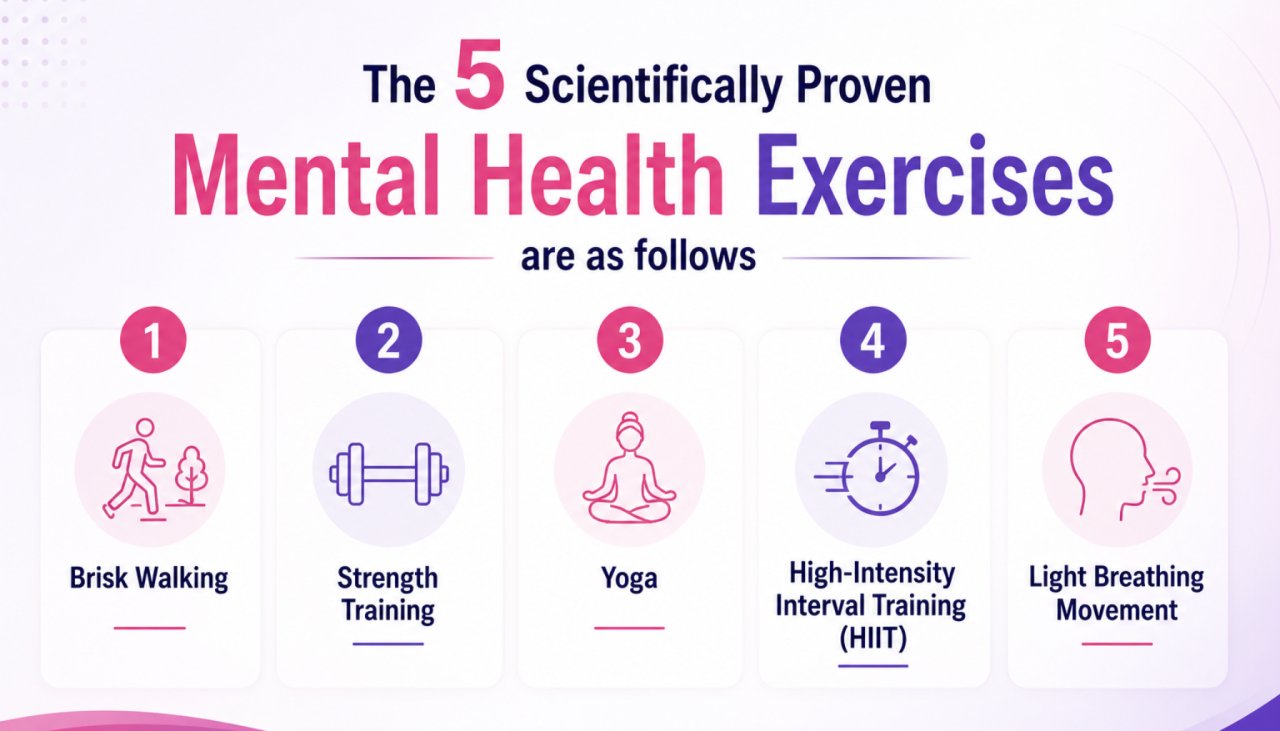
The 5 Scientifically Proven Mental Health Exercises are as follows:
1. Brisk Walking
Are you the only one thinking about how a simple activity like a brisk walk can affect your mental health? Well, it has a lot more than you can imagine. This effortless activity seems too plain to be given attention, but in reality, it is not. And it can be considered one of the best exercises for mental health.
Here’s how you can do it:
-
You can start walking for 20–30 minutes at least every day. Initially, you might struggle, but once you kick in, you won’t feel like missing it a day. Moreover, the good news is that it helps to lose that extra inch of your belly and side waist.
-
Remember to maintain a steady pace so that you don’t get exhausted within the first 10 minutes.
-
Repeat 5 days a week for optimal benefits.
What changes:
-
Thoughts slow down
-
Sleep improves
-
Mood lifts, often within days
2. Strength Training
No, there’s nothing to panic about when you hear about the term “strength training." Also, you don’t actually need to hit the gym or spend bucks. All you need to do is to follow the simple steps mentioned below.
How to do it:
-
Train 2–3 times a week
Focus on:
-
Squats
-
Push-ups
-
Keep sessions to 30–40 minutes
What changes:
-
Anxiety becomes less intrusive
-
Mood stabilizes
-
A sense of control returns
In studies on exercise for depression and anxiety, resistance training shows steady, repeatable gains. The result might not be instant, but it is totally reliable.
3. Yoga
If you have been wondering whether the yoga mat that you bought a year ago has been simply wasted, then it's time to roll out your yoga mat today. What are you waiting for now? Come on, all you need to do is follow the steps below.
Simple routine:
-
Start with 5 minutes of slow breathing
-
Followed by 10 minutes of stretching
-
5 minutes of stillness
-
Practice asanas, pranayama, and deep meditation
-
Marjaryasana-Bitilasana, Balasana, Viparita Karani, etc., are known to soothe your nervous system.
What changes:
-
Heart rate slows
-
Muscles release tension
-
The mind follows that signal.
4. High-Intensity Interval Training (HIIT)
What exactly is high-intensity training? Let’s understand it first. High-Intensity Interval Training, or HIIT in short, is a set of workouts that alternates short bursts of very intense exercise with periods of rest or lower-intensity activity. The key idea is to push your body close to its maximum effort during the “work” intervals, then recover briefly before repeating.
For example, a simple HIIT session might look like:
-
30 seconds of sprinting
-
1 minute of walking or slow jogging
-
Repeat for 10–20 minutes
These workouts can include exercises like running, cycling, jumping, or bodyweight moves such as squats and burpees.
What changes:
-
Immediate boost in mood
-
Noticeable drop in stress
-
Increased energy
This works well for those who feel pressed for time but still want the best exercise for mental health option.
5. Light Breathing Movement
Not all exercise involves strain. Some of the most effective ones involve restraint, such as light breathing movement.
You can incorporate the following steps:
-
Inhale for 4 seconds
-
Hold for 4 seconds
-
Exhale for 6 seconds
-
Repeat for 5–10 minutes
More to add:
-
Gentle neck rolls
-
Shoulder rotations
What changes:
-
Breathing steadies
-
Panic reduces
-
Focus returns
This is one of the simplest forms of mental fitness exercise, yet often overlooked by many of us.
Wrapping Up
There is no single mental health exercise that works for everyone. What works best is by incorporating the mentioned practices.
Choose one method that works for you. Do it daily. And keep it simple. The mind rarely changes in a single moment. It shifts, slowly, through what you do each day.
But remember, exercise alone may not be sufficient. Medical support, including prescribed treatment, becomes necessary. You can access medication through us at MedeHub, which can make that step easier.